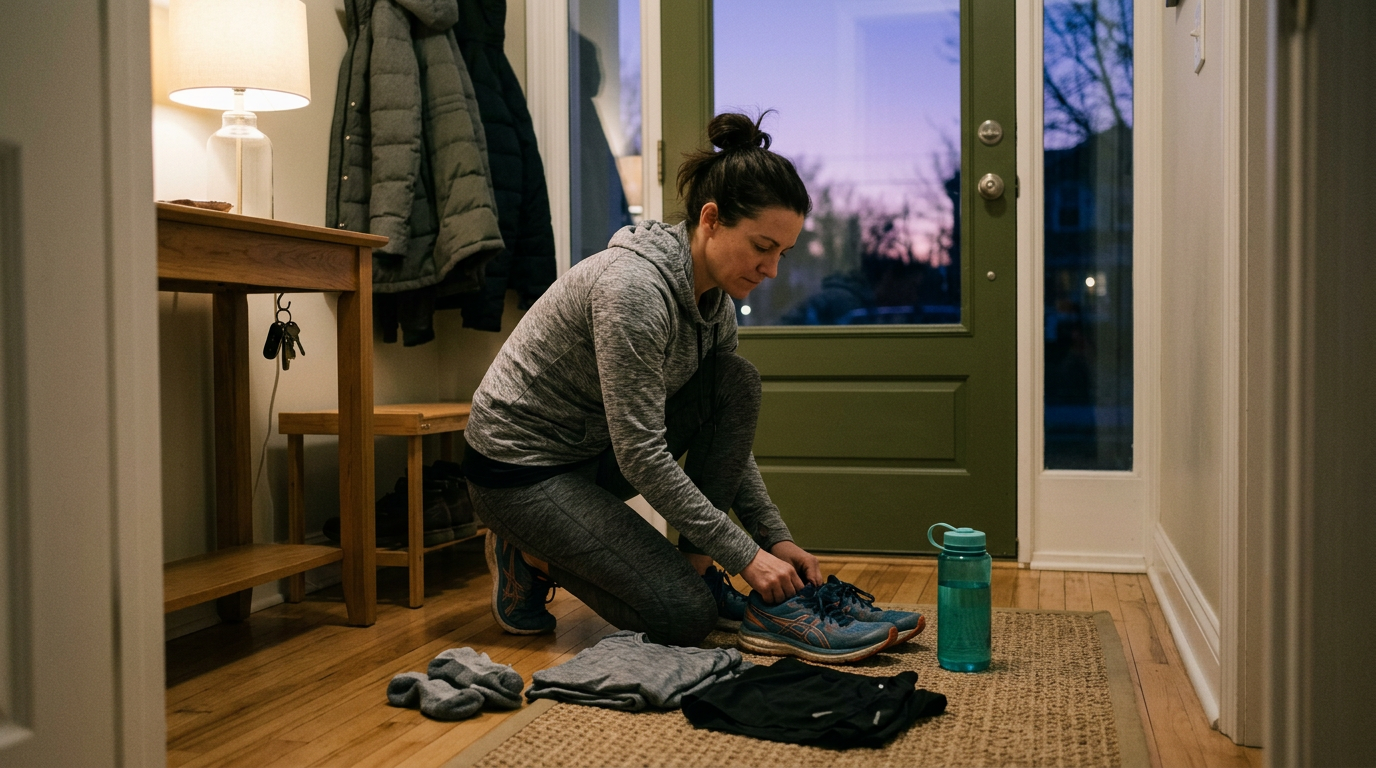
There is a version of morning routine advice that involves rising at four, plunging into cold water, journaling three pages, meditating twenty minutes, and completing a workout before most people have opened their eyes. It photographs beautifully and survives contact with an actual life for about nine days. The useful question is smaller and more interesting: what would have to happen in your first hour for the rest of your day to go better? Usually the answer involves three or four modest things, arranged so your clearest thinking lands on what matters most.
What makes a morning routine actually work?
A working routine protects your first clear hour and puts it toward something that matters, while removing the decisions that drain you before the day starts. It fits your actual schedule, survives a bad night, and consists of few enough elements that you can complete it without hurrying.
Three properties separate the routines that last from the ones that photograph well. They are short enough to survive a hard week. They are anchored to something fixed, usually waking or coffee, so they need no motivation to begin. And each element earns its place by changing how the following hours feel, instead of appearing because someone successful mentioned it in an interview.
The measure of success is simple. A routine works when your day goes better on the days you do it, and when skipping it once causes no guilt at all.
Why does the first hour matter more than the rest?
Attention is at its cleanest before the day fills it. A morning spent inside your inbox and feeds hands that clarity to other people's priorities and trains your mind for switching. What you do first tends to set the pattern the following hours follow.
The most consequential decision in most morning routines is what you avoid. Opening a phone within minutes of waking pulls you straight into a stream engineered to fragment attention, which is exactly the training described in our guide to stopping doomscrolling. The mind that starts the day in a feed spends the rest of it reaching.
There is a second reason the early hour is valuable, and it has nothing to do with willpower folklore. The morning is simply the part of the day that other people have made the fewest claims on. Protecting it is less about biology than about being the only reliable window that stays yours.
What actually belongs in a morning routine?
Light, movement, water, and one deliberate block of attention on something that matters to you. Add a few minutes of stillness if it helps you settle. Four elements, twenty to forty minutes, and none of them require buying anything or waking before your body is ready.
Morning light does real work by anchoring your circadian rhythm, which in turn supports the sleep that makes tomorrow's morning possible. Ten minutes outdoors beats any indoor substitute, and it pairs naturally with movement.
Movement can be genuinely small. A ten minute walk changes your state more reliably than a second coffee, and the state you begin the day in tends to persist. Water addresses the mild dehydration everyone wakes with, and it costs nothing to fix.
The deliberate block is the piece that makes the routine worth having. Twenty five focused minutes on your own priority, before the day's demands arrive, is the difference between a morning that sets you up and a morning that merely happens. Our guide to focusing better covers how to structure that block so it produces real work.
How do you build one that survives a bad week?
Start with a single element attached to something you already do, and run it for two weeks before adding the next. Define a minimum version that takes five minutes for hard days. A routine you can shrink survives; a routine that must be complete or abandoned quietly disappears.
The minimum version deserves particular attention, since perfectionism is what kills most routines. Decide in advance what the five minute version looks like: step outside with your coffee, drink a glass of water, and write one line about what matters today. On a morning after a broken night with a sick child, that version keeps the identity intact, which our guide to identity based change explains is the part that actually compounds.
Anchor each element to an existing cue instead of a clock time. After I pour coffee, I step outside. After I brush my teeth, I write my one line. Cue based plans hold up far better than intentions, a principle covered in our guide to implementation intentions, and our article on how long habits take to form sets honest expectations for the first month.
Do you have to wake up early?
No. What matters is the quality of your first hour, along with getting enough sleep to have a first hour worth protecting. Waking at five after six hours of sleep trades something valuable for something that merely looks disciplined, and the trade rarely pays.
Chronotypes differ genuinely, and some people do their best thinking at ten at night. If that describes you, keep the structure and move it: protect the first hour after you wake, whenever that is, and let the early rising folklore belong to people whose biology suits it.
Sleep sets the ceiling for everything a morning routine can deliver. Cutting sleep to gain routine time is borrowing from the process that made your thinking possible, which our guides to falling asleep faster and getting more deep sleep cover directly. Protect the night first, then build the morning on top of it.
What about mornings with kids, care duties, or shift work?
Shrink the routine until it fits the life you actually have. Five honest minutes counts. In seasons where the morning genuinely belongs to other people, move your protected block to whenever your first quiet stretch happens, and let the principle survive even when the timing cannot.
Parents of small children often hear morning routine advice as a description of a life they no longer live, and they are right about the standard version. The adapted version works: light and movement happen with a stroller, the deliberate block happens during a nap or after drop off, and the stillness happens in a parked car for four minutes before going inside.
The principle underneath all of these adaptations is worth stating plainly: the routine exists to serve the day, and any version that adds guilt to a season that is already hard has stopped doing its job.
Shift workers face a harder problem and the same solution. Your first hour after waking is your morning, whatever the clock says. Anchor to waking instead of to sunrise, and get light exposure whenever your day begins.
Where does a morning routine fit in a mental longevity practice?
A morning routine is intentional living made concrete and repeatable. It puts your best attention on what you value, protects the sleep and movement that keep a brain healthy, and turns your priorities into something that happens daily instead of something you mean to get to.
Mental longevity is the lifelong capacity to think clearly, regulate your inner state, adapt to change, keep learning, maintain meaningful connections, and live intentionally. A morning routine touches nearly every clause of that sentence in the space of forty minutes: clear thinking protected, state regulated, learning given a reliable slot, and the day's direction chosen by you instead of inherited from your inbox. That is why it recurs throughout what mental longevity means as a practical entry point.
Routines also hold better when someone else knows about them. Members inside HumanOS, our community for building a durable mind, share what their first hour actually looks like on ordinary days, which is more instructive than any idealized version on the internet.
How long should a morning routine be?
Twenty to forty minutes suits most lives, with a five minute version reserved for hard days. Length matters far less than consistency and than what the time is spent on. A short routine you complete daily outperforms an elaborate one you manage twice a week.
Should I skip my phone in the morning?
Keeping it away for the first thirty to sixty minutes is one of the highest value changes available. The most reliable method is charging it outside the bedroom, since willpower at six in the morning is unreliable and distance requires none. Our guide to digital minimalism covers the wider version.
What if I am simply not a morning person?
Then build the same structure around your own wake time. Chronotype is real and the principle is portable: protect your first clear hour, get light and movement early in your day, and put your best attention on something you chose. The clock time matters much less than the sequence.
How long before a routine feels automatic?
Expect several weeks, with wide variation by person and by habit. Simple cue based actions settle faster than complex sequences. Our guide to how long habits take to form covers the research and why the popular twenty one day figure sets people up for disappointment.