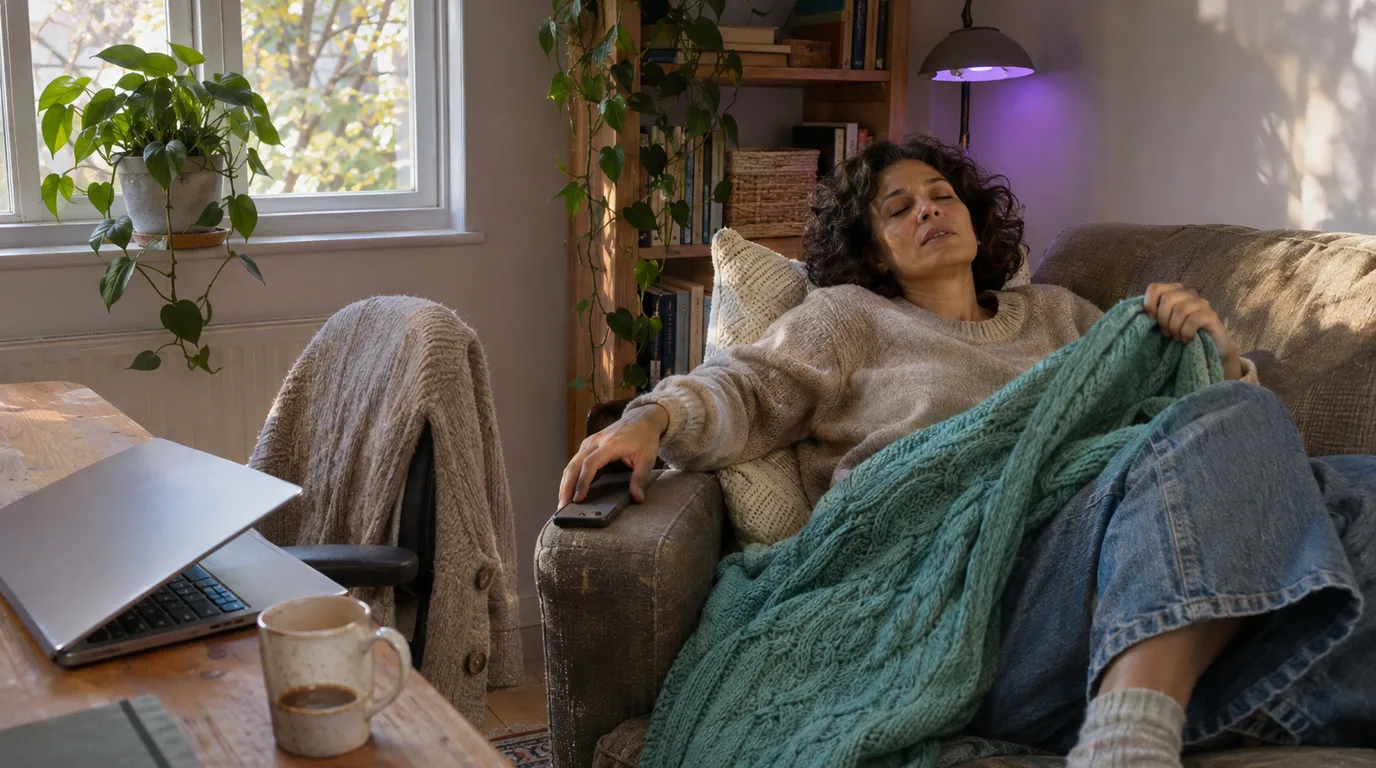
A power nap is a short sleep in the early afternoon, about 10 to 20 minutes, kept short to avoid the grogginess a longer nap can bring. In a 2006 sleep study, 10 minutes of sleep gave the fastest lift in alertness and mood. Take it early in the afternoon, set an alarm, and judge it by how clear you feel half an hour later.
It's 1:30pm and you've read the same email 3 times
“Almost everything will work again if you unplug it for a few minutes, including you.”
It's 1:30pm. Lunch is done, the afternoon meeting is at 3, and you've just read the same email for the third time without taking in a word. Your eyelids feel heavy and your hand is already moving toward a second coffee. Somewhere in the back of your head a voice says that lying down for 20 minutes would be lazy.
At Healing Waves we see that moment differently. Mental longevity is the lifelong capacity to think clearly, steady your inner state, keep learning and stay connected, and all of it runs on recovery. We call that capability Restoration: sleep at night and deliberate rest during the day. A power nap is one of the simplest ways to train it, because it treats rest as a skill you plan, the same way you plan a workout or a meeting.
So the standard we use is practical. A good nap is one that gives you a clearer afternoon and still lets you fall asleep easily tonight. This guide shows you how long to nap, when, how to wake up without the fog, and how to tell over 2 weeks whether it's doing its job.
How long should a power nap be?
Aim for about 10 to 20 minutes of actual sleep. In the study below, that was long enough to lift alertness and short enough to avoid the grogginess the 30-minute nap caused in that study.
The clearest test of nap length comes from a study at Flinders University in Australia, published in the journal Sleep in 2006. Brooks and Lack limited 24 healthy young adults to about 5 hours of sleep at home, then had them nap at 3pm for exactly 5, 10, 20 or 30 minutes of sleep, or skip the nap. The 5-minute nap did little. The 10-minute nap improved sleepiness, fatigue, vigour and performance on thinking tasks straight away, with some benefits lasting up to 155 minutes. The 20-minute nap helped too, though its benefits took about 35 minutes to appear. The 30-minute nap left people foggier and slower at first, and only then did they improve.
The study counted minutes of sleep, not minutes lying down. It can take a few minutes to drift off, so a 20-minute alarm may give you only 10 to 15 minutes asleep. The people in this study were short on sleep and didn't nap regularly, so your own best length may differ a little, and the plan below helps you test it.
What the research says a nap can do for your afternoon
A nap gives your thinking a modest lift for the next couple of hours, and alertness gains the most. It sharpens an afternoon and leaves your nights to do the bigger repair work.
The best summary is a 2021 review in the International Journal of Environmental Research and Public Health. Dutheil and colleagues pooled 11 studies with 381 working-age adults. After a nap, overall thinking performance improved, and alertness showed the clearest gain. The benefit lasted mainly up to 2 hours after waking. Naps taken before 1pm gave better results than later ones, and the benefit held regardless of sex and age.
Almost every study took place in a sleep laboratory, and the authors say more research in real working conditions is needed before workplaces adopt napping. The naps in that review averaged 55 minutes, much longer than a power nap, so it tells you naps help in general and the Flinders study tells you about the short ones. Our research page on naps walks through both papers, including what long naps in later life do and don't predict.
Why you sometimes wake up feeling worse
That heavy, slowed-down feeling right after a nap is called sleep inertia. In the Flinders study it showed up after the 30-minute nap, not the 10-minute one, which is why a power nap is kept short.
You saw it in the Flinders study, where the 30-minute nap made people slower before it made them sharper. The 2021 review found mixed results in the period just after waking too, which fits the same picture. The fog passes, but if you have a call 5 minutes after your alarm, a long nap is the wrong tool.
Keep the nap short, and give yourself a few minutes of light, water and movement before anything that needs your full attention. If you can't sleep at all, lying still with a guided practice is still useful. Our guide to yoga nidra and non-sleep deep rest shows you how to rest deeply while staying awake, and the physiological sigh can help your body settle in the first minute.
A nap lifts the afternoon, and your nights carry the rest
“the way to a more productive, more inspired, more joyful life is getting enough sleep.”
At Healing Waves we treat habits as the vehicles and capabilities as the destination. A power nap is a habit. Restoration is what it serves, and Restoration lives mostly in your nights.
That changes how you read your own need for a nap. An occasional nap after a short night or before a long evening is good planning. Needing a long nap every single day to get through the afternoon is information about your nights. When Restoration is strong, you wake with energy that lasts past lunch, and a nap feels like a bonus. When it needs work, you dread the alarm, coffee is doing structural work by mid-morning, and weekends go on recovering from the week.
If that second list sounds familiar, start with the night. Our guides on how to get more deep sleep and how to fall asleep fast are the place to begin. And if you're sleepy most days despite decent nights, snore loudly, wake up gasping or never feel refreshed, talk to a doctor. Heavy daytime sleepiness can point to a sleep problem that rest alone won't fix.
Try this today: your 20-minute power nap
“even the most driven achievers need to take time to relax.”
Plan it like any other appointment, so it happens on the day you need it most.
Step 1: pick your window
Choose a time between lunch and about 2pm. The 2021 review found naps before 1pm worked better. An early nap also leaves more time for your sleep drive to build again before bed.
Step 2: set a 20-minute alarm
Put your phone face down with the alarm set for 20 minutes. That may give you 10 to 15 minutes asleep. In the Flinders study, 10 minutes of sleep gave the quickest lift and 20 minutes helped after a short delay.
Step 3: make it easy to drift
Lie down or lean back somewhere quiet. Darken the room or cover your eyes, keep a layer over you because still bodies cool, and take 3 slow breaths with a long exhale. If you don't fall asleep, keep resting until the alarm; quiet rest is still rest.
Step 4: wake up on purpose
When the alarm goes, sit up, get some daylight and a glass of water, and move for a minute or 2 before you open the laptop.
How you'll know it's working
You'll know a power nap is working when your afternoon gets clearer and your night stays easy. Milner and Cote's review in the Journal of Sleep Research notes that people vary widely in how often they nap and in how much alertness they gain from it, so your own record is the best guide.
Run it for 2 weeks. Before each nap, rate your alertness from 1 to 10, and rate it again 30 minutes after you wake. Each night, note whether you fell asleep as easily as usual. If the afternoon number rises and your nights hold steady, keep it. If you wake foggy, shorten the alarm by 5 minutes. If your nights get worse, nap earlier or switch to non-sleep deep rest.
Then look at the bigger picture once a month. Rate your Restoration from 1 to 5 using the lived signs above, alongside the other 5 capabilities, and let the trend across months guide what you work on next. To see where Restoration sits today, take the free Mental Longevity Profile, and read the six capabilities of mental longevity to see how rest feeds the rest of your mind.
Frequently asked questions
Is it healthy to have a power nap?
For healthy adults, a short early-afternoon nap is a useful tool. A 2021 review of 11 studies found that naps improved thinking performance, especially alertness, for about 2 hours. If you need long naps every day, talk to a doctor, because heavy daytime sleepiness can point to a sleep problem.
How long should a power nap be?
About 10 to 20 minutes of sleep. In a 2006 study of 24 adults, 10 minutes of sleep gave the quickest lift, 20 minutes helped after a short delay, and 30 minutes caused grogginess first. A 20-minute alarm may give you 10 to 15 minutes asleep, because it can take a few minutes to drift off.
How do you power nap when you can't fall asleep?
Lie still with your eyes covered, take a few slow breaths with a long exhale, and keep resting until your alarm goes. A guided practice such as yoga nidra, also called non-sleep deep rest, gives your mind something to follow while your body settles.
What is the best time for a power nap?
Early in the afternoon. The 2021 review found that naps taken before 1pm gave better results than later ones. An early nap also leaves more time for your sleep drive to build again before bed.
Sources
- Dutheil et al. (2021), Effects of a Short Daytime Nap on the Cognitive Performance: A Systematic Review and Meta-Analysis, International Journal of Environmental Research and Public Health
- Brooks and Lack (2006), A brief afternoon nap following nocturnal sleep restriction: which nap duration is most recuperative?, Sleep
- Milner and Cote (2009), Benefits of napping in healthy adults: impact of nap length, time of day, age, and experience with napping, Journal of Sleep Research